I’ve finally had the opportunity to attend some Filmable events lately! A few weeks ago, they hosted the Every Frame a Painting duo’s presentation of THE FOUR FACTORS: How South Korea transformed its film industry and how Canada can too a few weeks back. In the immediate aftermath, as people asked what I thought, I was precariously oscillating between optimism and pessimism… but to be honest, my needle was mostly favouring the pessimistic side.

The presentation itself was great! Please catch it if you have the opportunity. It does a great job of highlighting and breaking down the impressive and inspirational rise of the South Korean film industry with stats such as:
- South Korean cinema went from making 16% of the domestic box office in 1993 to 64% in 2006!
- In 1999, Shiri became the top-grossing film in South Korean history, selling 5.78 million tickets. Not the top-grossing domestic film. The top grossing film, period. Remember what else came out in 1999? Titanic. Yup. It beat TITANIC.
- In 2006, The Host sold 13 million tickets.
- Also of note in 2006, filmmakers organized protests to protect local screen quotas, picket signs and all.
The presentation also does a great job of breaking down four key factors that contributed to the South Korean film boom:
- POLITICAL: Governmental incentives, funding of not only films but film-adjacent infrastructure, and internal bureaucracy.
- CULTURAL: Film festivals, film magazines, university clubs, family dynamics.
- BUSINESS: Investment from major family-owned conglomerates (chaebol), venture capital, and producers involved in reshaping how films are funded, distributed, and exhibited.
- ARTISTIC: A new generation of filmmakers educated at national film schools permitted to develop their skills through shorts and features…
…and allowed to fail!
Bong Joon Ho’s Sleeping Dogs Never Bite took over two years to break even financially, but that didn’t kill his career. Cut to twenty years later:

My pessimism at the presentation was mostly caused by how it exposed the convoluted film production system in Canada, specifically how things completely fall apart once the film is actually made and needs to be effectively promoted, distributed, and exhibited. It left one feeling that it’s a miracle if a Canadian film even makes it to the big screen. I mean, can YOU name a Canadian film you saw on the big screen in 2026?
Living in Vancouver, a major city, I was able to catch Nirvanna the Band the Show the Movie and Blue Heron. Two’s not a lot, but I still feel it’s more than your average Canadian.
Someone in the audience asked a really great question about this:
“How is the average, casual viewer supposed to recognize and seek out Canadian films?”
Still, the presentation failed to convince me that the South Korean model can (or should) be emulated in Canada.
Some arguments immediately jumped to mind on the differences between the two countries before I even attended the presentation:
- How does having a population that doesn’t speak English affect South Korea’s industry and its success?
- Comparing South Korea and Canada’s geography is basically comparing apples and oranges.
The big city VS small town/village disconnect is so real in Canada.
Unless you haven’t lived outside of a major urban centre, you have no idea. I grew up in a village. We didn’t have a single set of traffic lights. I didn’t get on my first public bus until I visited Ottawa when I was in high school. We didn’t even have a Tim Horton’s, let alone a movie theatre. Catching a film on the big screen meant an hour’s drive to Moncton. It was a whole thing.
It didn’t always used to be that way though…
There also used to be more trains.
I was stunned to learn that my grandparents’ generation went to Montréal more than my parents’ (or my) generation. Because he was a longshoreman, my grandpa had a pass for unlimited train travel. A quick trip to Québec was no biggie. Sure most everyone has a car now, but I’d argue that a road trip as an individual is more of an ordeal than hopping on a train.
And there used to be more local movie theatres. Small, independent single-screen places. The town a fifteen-minute drive away had one, but it closed before I was born.
More trains, more local screens… in some ways, we used to be more like South Korea.
Speaking of growing up in the middle of nowhere, the presentation lost me at their praises of Korea’s megacorps and of their vertical integration models.
Miss me with that shit, I’m from New Brunswick.
We have our own chaebol.
New Brunswick’s the province that most people drive through on their way to PEI or Nova Scotia. The province about which most people apologetically tell me that they didn’t really stop to visit anything there.
“I remember a lot of trees?”
Bustling business and a thriving film industry don’t exactly jump to mind when people think of New Brunswick.
But a single company that sells everything from navy ships to lumber to gas to radio airwaves to fries to toilet paper? You don’t need to renew your passport for that. And I doubt that adding film to a company never-ending list of holdings would count as a positive. Nevermind that that company has already faced their share of censorship scandals.
Vertical integration benefits the megacorps and little else. Especially in a country often described as three (soon to be two) monopolies in a trench coat. It evidently does not make for a healthy economy, or a healthy society, or an especially creative one…
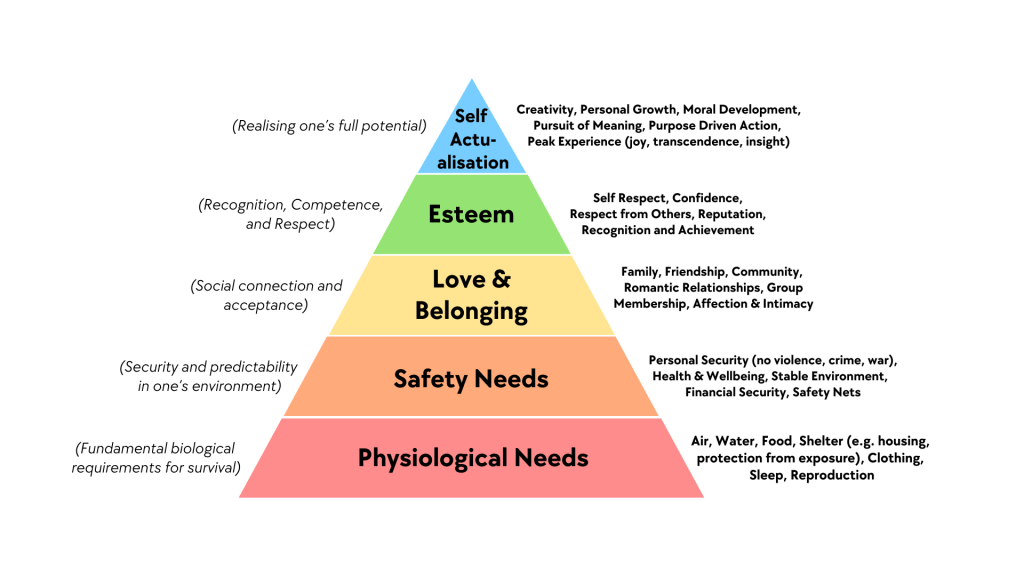
Good old Maslow and his hierarchy of needs, baby! It’s funny what things will forever have a home in some recess of your brain, but this graph has been in there since the day my animation prof Mark Mayerson shared it with us at Sheridan (as it pertains to story/character development, but it obviously goes beyond that.)
ANYWAY!
To link the topic of how out of control capitalism isn’t doing us any favours back to the previous one of geography and access to movie screens, one can’t help but consider the impact of the Cineplex monopoly in Canada…
What struck me in the days after attending the presentation was the parallels between Canada’s primary economic sector and our film/television/animation industries.
Canada’s extraction mindset is alive and well, and it’s on full show right now.
It’s fine and dandy to deplete fish stocks and drill baby drill for short term gains, but it’s not sustainable. It doesn’t make for a healthy economy, it doesn’t make for a healthy environment, and it doesn’t make for a healthy society.
Just as we need a primary sector that’s focused on renewables, we need a renewable film/TV/animation industry. And that comes in the form of a healthy domestic industry.
How has that hard pivot to American service work treated us?
One of the reasons I’d love to work with the NFB one day, on top of it being such a beloved Canadian institution, is because of their vested interest in the success of their productions. The extent to which they push both on the festival circuit and the press both here at home and abroad is unlike anything else, not to mention their archival resources. Their shorts consistently show up on the Academy Awards nominees list year over year not only because of the creativity that they demand and foster, but because of the amount of work they invest in marketing. Which, let’s face it, is work that your average filmmaker would rather put into a film.
(Or, as is also increasingly the case in the publishing world, a writer into their next book.)
Meanwhile, Telefilm may tout the percentage of Canadian films that made it to the box office that were supported by their funding, but you don’t hear them bragging about the abysmal percentage of revenue created by Canadian films at the domestic box office…
Some fun facts:
- If you look at the Canadian anglophone market, it practically sits at the bottom of the list. WORLDWIDE.
- The top 3 spots go to Iran (yes, Iran), the US, and South Korea.
- Nirvanna the Band the Show the Movie, arguably THE most Canadian (well, Toronto) movie released in a hot minute, did better at the Korean box-office than the Canadian one. Yup. AND it was released in theatres by a YOUTUBER! AND said YouTuber was given the screening schedule from South Korean exhibitors months ahead of time so they could do an effective marketing push ahead of the screenings. Compare that with a few days’ notice from Cineplex to Canadian productions.
Oh yeah.
What about Québec?

Québec’s doing great.
While English Canada is one of the world’s worst performers when it comes to their domestic box-office, Québec sits comfortably with most European nations. And I don’t think it’s because they have open access to their box-office numbers while the rest of the country locks that shit down.
Spin things however you want, having a dominant language that isn’t English and a distinct cultural identity creates demand for stories that speak about and/or to that specific market. And those stories don’t need to stay within that market’s borders. And that language and cultural identity are great buffers to keep American influences in check.
It’s not patriotism.
It’s just life.
Could Canada’s entertainment industry benefit from more private investors? Yes. But let’s not go crazy idolizing vertically integrated conglomerates. The fact that Canadian films get more revenue from independent exhibitors speaks volumes.
Could Canada’s public sector be doing more? Yes. From quotas (where are the CanCon requirements for the big screen and streamers?) to ensuring the financial success of their investments, the Canadian industry I’d argue that Canada could learn more from both South Korea and from what Québec is doing at home.
Is there cause for optimism?
I’m not sure.
While the current federal government is announcing new investments to Canadian media production, it comes at the expense of the so-called Netflix tax. Is pouring more resources into production while continuing to ignore problems with distribution and exhibition going to amount to anything?
If a tree falls in the forest and there’s no one around to hear it, does felling fifty more trees make a sound?
…is it sustainable?

