If I had to set a relationship status between myself and animation (and picture books) these days, it would look something like this:

At my first (paid) job in the industry, my cubicle was close to the producer/director cluster of another show. One day, I overheard the producer loudly complaining about a script:
“This writer clearly doesn’t have any children. There are no adults in this sequence. They’re completely unsupervised!”
That producer, I’d still argue today, had clearly forgotten what it’s like to be a kid watching TV.
When I think back to some of the cartoons that marked my childhood…
Les Moomins:


Anne… la maison aux pignons verts:


Les mystérieuses cités d’or:

(Once upon a time, children’s programming on la SRC, AKA the French CBC, absolutely SLAPPED.)
…not once do I recall giving a shit about the characters being supervised.
If anything, it was the fact that these characters were out there living their unsupervised best lives that kept us coming back day after day. From luring the demonic-looking Lady of the Cold, getting drunk off of raspberry cordial, and dealing with booby-trapped South American temples, not only were these characters unsupervised, they were out putting themselves in (varying degrees) of dangerous situations.
Situations and characters and concepts overall that, when thinking back on them, makes me go “They would NEVER let you make anything like that today.”
SIDENOTE
At the end of each episode of Les mystérieuses cités d’or, there was always a mini (live-action) documentary that covered aspects of the episode or of South American history and/or culture in general. Although some of the language is now dated, it’s the animal sacrifices, hunting practices, and nudity that jump out when you compare them to programming aimed at children today.
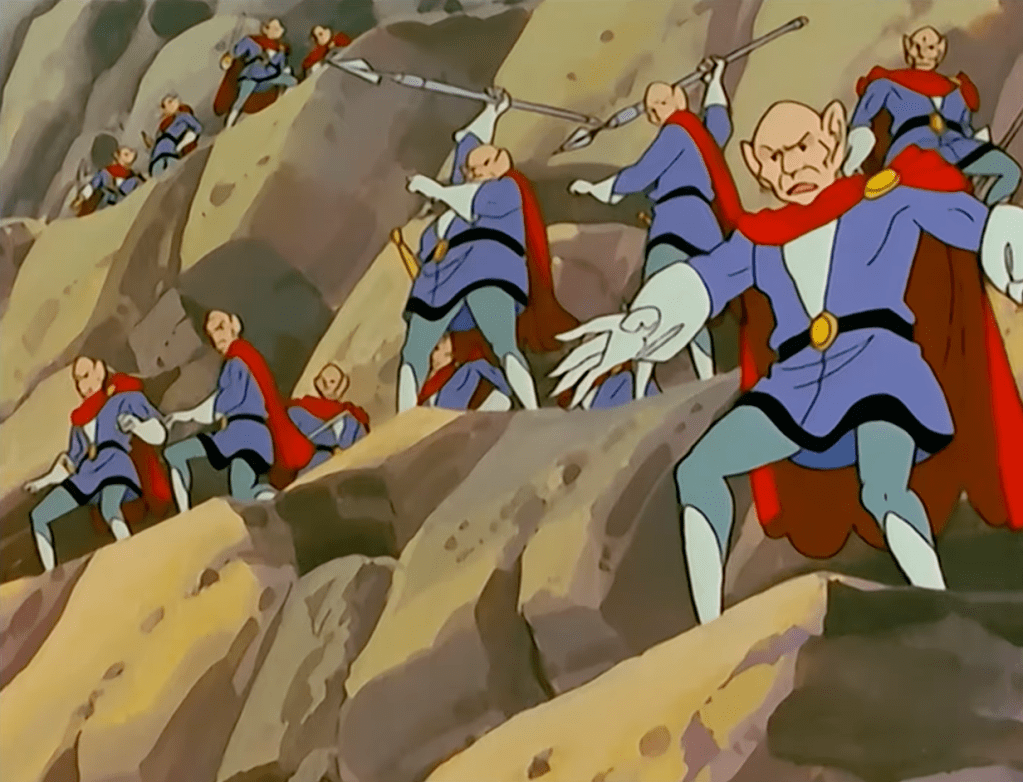
We were terrified of the Grooke. But we also squealed with glee whenever we realized that we were watching an episode where it would show up.
Getting scared was FUN.
I think that most children crave a certain degree of escapism. I know I did.
Needless to say, parenting today looks wildly different. Which means that being a kid must feel different, too. Not only do parents track what their kids watch more closely than ever, they’re being tracked in every sense of the word…
For a few short months, before we moved to Vancouver, we lived in a townhouse in a quiet and secluded GTA suburb. Our neighbours had a young son. Not once did I see him walking without a parent holding his hand from the car to the house. Forget being allowed to play in the front yard. Or exploring the lakeshore.
My own childhood looked wildly different, and I just remember feeling so sad and sorry for him.
I wonder what his life looks like now.
It’s no wonder the kids are running for the hills (of YouTube) for some semblance of autonomy.
Okay, so what am I getting at, exactly?
The trouble with having children as an audience.
The trouble with having children as an audience is that you effectively have an audience with little to no agency. And this is true across a variety of mediums:
In books…
(And here I’m specifically thinking of picture books.)
Not only do the parents (or grandparents, or aunties, or uncles, or whoever) buy the book, they’re also often the only ones who can consume their words first hand. Until the kid learns to read, that is. And once the kid learns to read, the kid’s usually over picture books.
In films…
Parents buy the movie tickets and have to be present at the screening – if the family can manage to make it out to a theatrical release in the first place. Therefore, a “kids’” movie has to be palatable to the whole family.
In television…
TV in the pre-streaming days was different. Let’s get that out of the way first.
As a kid, you had some semblance of independence over your media consumption. As long as you weren’t fighting with anyone for the remote. Your parents didn’t WANT to watch your stupid cartoons with you, so you were actually on your own.
Now? The streaming platform themselves act as a barrier if you really think about it.
I like the idea of making things with kids in mind fine enough, but it’s something that I find myself struggling more and more with as time goes on, in large part because children’s media is geared less and less towards actual kids.
It’s geared at their parents.
Or, if it is geared at kids, it reeks of judgement. It doesn’t speak to them, it talks down at them.
I have a vivid memory of wondering why my grandmother used baby talk when I was a kid.
“Mom, does grandma think we’re stupid?”
The animation industry also happens to love judging and caricaturing its characters. A big no-no in other dramatic arts. This quote from Uta Hagen is one of many that illustrates a lot of the trouble with the way characters are often approached in the world of animation:
“Whenever I retained my first images or used them as guidance for my character I was in big trouble. However, when I worked subjectively through the play from its roots — to discover who ‘I’ am, what ‘I’ want, what ‘I’ do — I ended up with something quite different, with deeper human meaning and no ready-made clichés. Jumping for the illustration of the first image is almost an automatic trap for the inexperienced actor. It may even manifest itself in something as obvious as crying at the moment when he feels sorry for the character, though the character himself wouldn’t shed a tear. The actor is providing the tears that eventually should be in the eyes of the audience. It doesn’t necessarily mean that the character is moved. The character is in action, struggling.”
I do think that this proclivity to judgement of characters bleeds into the industry’s tendency to judge its audience.
When I write (or direct), I’m very much the audience. I can’t pretend to know what goes on in anybody else’s brain, no matter their age. I speak to what speaks to me, and I can only hope that it’ll resonate with someone else. The specific is universal. It’s one of my core beliefs.
And it’s a viewpoint I hear all the time from my favourite artists.
“I don’t write for children. I wouldn’t know the first thing about writing for children.”
(From Charles Schulz’s acceptance speech when A Charlie Brown Christmas won the Emmy for Outstanding Children’s Program in 1966.)
That said, feedback from gatekeepers and execs tend to tell another story these days…
These days, I tend to actively avoid watching animation.
I’ve often said it’s because it feels like work. And in a way, it does. It’s hard to turn my work brain off when I watch anything that’s animated.
But that’s a cop-out. Because my writing brain, my editing brain, my acting brain, my directing brain — all of my brains and all of my hats are very much at the party when I consume media, no matter the format.
There’s also the argument that I remember hearing years ago from some Pixar animators who said they avoided animation to keep their wells fresh, so to speak. And say what you will, animation can have a quasi-incestious tendency to stay in its bubble, to constantly reference and influence itself, and to thereby get stale.
Cue the new trend that studios eagerly scramble to emulate…


There’s something more to it, though.
To quote Marie Kondo, it just doesn’t spark joy anymore.
I do think a lot of it has to do with the fact that animation is still very much considered a medium for children. And I don’t enjoy the way that audience is being considered by the industry that powers the medium.
(There’s also the issue of the industry liking to treat its workers like children, but that’s probably a whole other post…)
What sparks joy these days lands on the live action side of it all. Reading scripts and plays. Going to acting class. Watching stuff that was made for fellow grown-ass adults. Filmmaking. Writing. Studying all of it. Not sure if there’s a jump to be made, or how exactly to go about it. But finding like-minded people, having fun, being brave, and putting work out there seems like a start.
Even this website revamp has been an opportunity to intentionally shed and rework the way I’ve been feeling about myself and the changes I’ve been going through these past few years…
I don’t know. Maybe I’m just finally growing up.
But what about Abbas Kiarostami’s Where is the Friend’s House?

Doesn’t it qualify as a movie for children? It was made through Kanoon, after all. And its protagonist is a little boy in grade school. It’s one of my favourite films of all time, and I was reduced to tears at the ending the first time I saw it. Not because it was sad, but because it was beautiful. Poetic. Perfect.
Kiarostami, man.
And what about Kummatty?

If it wasn’t for the Film Foundation and its wonderful virtual screening series, I don’t know that I ever would’ve stumbled on this gem. Playful. Magical. Such a visual treat.
I also feel the need to give a shoutout to Julian Glander and his Boys go to Jupiter.

I can’t remember the last time I went to the theatre to catch an animated film before this indie gem. With its bright colours and video game inspired use of 3D animation, it certainly has the looks of a film aimed at children.
That’s where it ends, though.
And that’s why I absolutely loved it.
Who says media aimed at children needs to look a certain way?
Who says media aimed at adults needs to look a certain way?
Who says anything needs to look like anything.
Another Uta Hagen quote springs to mind on this, where she talks about how “The shape of the wrapping or the package depends on what’s inside.”
“In comparing painting to acting I used to say that to paint an apple you have to see and to sense everything about the apple before you can come to a statement about it, and that if you combined that statement with your skill you might produce a canvas that had your mark. Picasso claimed you have to eat the apple first. He clearly wanted to come to full grips with his material and digest it before he gave it shape, before his statement came into being.”
Sometimes I wonder what my college-self would think of me now… but then again, it was her who fell in love with Italian Neo-realism, the French new wave, and who had way too much fun writing essays about their influence beyond their respective countries of origin. And outside film history class, my sensibilities were already proving to be at odds with commercial content aimed at children. Though inspired by real events I witnessed at a museum visit featuring children, my thesis film doesn’t cleanly tick any one box…
Is it a film for children? Maybe.
Is it a film for adults? Maybe.
Sixteen years later, I’m still very much in limbo.
But I’d rather be in limbo than stuck in a box.

