I recently started taking acting classes (more on that later, maybe) which means I’ve been reading a lot. From books on the craft, to finding material to bring to class… I’m back to reading plays again!
Recently, it’s been a return to Tennessee Williams.
I’d already read his Cat on a Hot Tin Roof and A Streetcar Named Desire, and I just finished Sweet Bird of Youth and The Glass Menagerie.
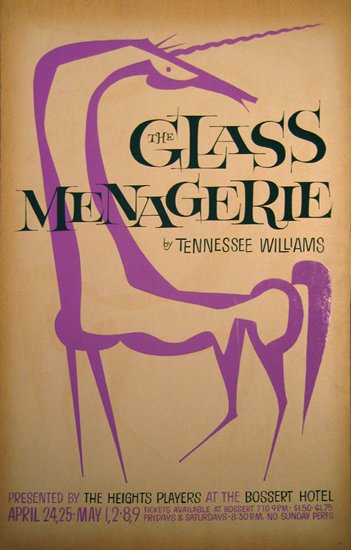
The copy of A Glass Menagerie that I got from the library happened to be a surprisingly thick volume for a play: the New Direction’s deluxe centennial edition. Along with the play, it also includes additional material from Tennessee Williams himself as well as essays, poems, reviews, and photography stills from various productions of the story for stage and screen.
Reading through these after I finished the play, I was struck by how so much of what I was reading resonates with today’s discourse on (maybe you guessed it?)… AI.
Because of course AI!
Before I even read The Glass Menagerie, Tennesse William already got the wheels in my head going with his Production Notes for the play:
Expressionism and all other unconventional techniques in drama have only one valid aim, and that is a closer approach to truth […] The straight realistic play with its genuine Frigidaire and authentic ice-cubes, its characters who speak exactly as its audience speaks, corresponds to the academic landscape and has the same virtue of a photographic likeness. Everyone should know nowadays the unimportance of the photographic in art: that truth, life, or reality is an organic thing which the poetic imagination can represent or suggest, in essence, only through transformation, through changing into other forms that those which were merely present in appearance.
The argument that photography didn’t kill painting — it gave it new life and essentially liberated it — is one that blew my mind when I first encountered it in my art history classes, and it’s one I’ve keep close to my heart ever since.
It echoes as my feet are still (somehow?) planted on the 2D side of the animation world, while much of the industry (and audiences) have been bewitched by the trend of “more realistic” 3D productions.
And it echoes as AI threatens to produce these “more realistic” results by removing humans from the equation (after using their work without permission or compensation, of course.)
But back to Tennessee Williams!
The Glass Menagerie was where it all began for us, the public. It opened in Chicago on December 26, 1944, then moved to Broadway and critical success. Of course, for the artist concerned, an overnight success is often anything but. In his essay The Catastrophe of Success, Tennessee describes the chasm between his years of desperate and applied work of finding himself with sudden material wealth and ease. For the first time in his life, he didn’t have to rely on writing new material to support himself.
It is only in his work that an artist can find reality and satisfaction, for the actual world is less intense than the world of his invention and consequently his life, without recourse to violent disorder, does not seem very substantial. The right condition for him is that in which his work is not only convenient but unavoidable.
Already, not even done with the essay, the parallel of AI got my wheels turning…
Work must be unavoidable.
Isn’t that the myth that AI claims to disrupt? Not only do you not have to work, you don’t even need to pay other people to do the work for you!
But once you fully apprehend the vacuity of a life without struggle you are equipped with the basic means of salvation. Once you know this is true, that the heart of man, his body and his brain, are forged in a white-hot furnace for the purpose of conflict (the struggle of creation) and that with the conflict removed, the man is a sword cutting daisies, that not privation but luxury is the wolf at the door and that the fangs of this wolf are all the little vanities and conceits and laxities that Success is heir to — why, then with this knowledge you are at least in a position of knowing where danger lies.
Any artist will tell you that the process of creation is the point. Is the joy. No matter how uncertain, lonely, or painful the journey.
The harder the squeeze, the sweeter the juice.
Security is a kind of death, I think, and it can come to you in a storm of royalty checks beside a kidney-shaped pool in Beverly Hills or anywhere at all that is removed from the conditions that made you an artist, if that’s what you are or were intended to be.
The work’s not just a matter of butt-in-chair discipline.
From the essays in the volume, we quickly learn that Tennessee Williams drew from his own life to write The Glass Menagerie.
Tennessee Williams is Thomas Lanier Williams’s nom de plume. Amanda Wingfield, Tom’s mother, is a veritable caricature of his own mother, Edwina (Gore Vidal recounts banter between the two at a dinner that would be perfectly at home in the play.) Then there’s the heartbreaking story of his sister Rose, who was diagnosed with schizophrenia and spent most of her adult life institutionalized after a lobotomy. The parallel to Laura is undeniable. Finally, the fact that the father figure, Mr. Wingfield, is absent in the play, seems to speak volumes of Tennessee’s relationship to his own father, Cornelius…
From Tony Kushner’s introduction in the volume:
It was possible for Tennessee to write The Glass Menagerie because by the time he left the shoe factory where his father was frozen in mid-level management, by the time he left St. Louis behind him, abandoning home, Edwina, and his sister Rose, he was already much more uphill climber toward this immense achievement than the hopeless fugitive, pursued by his two household Eumenides, to whom we bid goodbye at the light-extinguishing conclusion of Menagerie. Tom flees from the torments of memory, but the playwright was in active pursuit of them, or rather it should be said that he was pursuing the means to embody these tormenting spectres onstage.
Of course, AI is a misnomer.
It has no intelligence to speak of, and it has no life of its own to draw upon. It has no messy past, no complicated relationships, no deep, shameful secrets. It’s a cold machine, only capable of producing photocopies of photocopies of photocopies…
The final product is only the tip of the iceberg.
And, as it turns out, making the iceberg is all the fun. Even when it’s hard.
I went to a presentation of our advanced acting class’s work last week, where they presented their scenes, uninterrupted. It was fascinating to watch, because I’d had the chance to sit in on one of their classes a few weeks back (and to have one of the pair of actors in my class the night before for a make-up session.) Forgetting about the concept of “good” or “bad,” what happens in the class VS what happens on the stage is so much more fun to witness. To me, anyway. Because in class, it’s often especially about doing it “wrong,” precisely to get out of our heads about the need to think we’re doing it “right.” We flail. We put on funny accents. We scream at each other. We share. We cry.
The messy search is not the final product, but it’s absolutely necessary to it.
It informs it.
It resonates in it.
The final product is all the audience gets to see. But it’s such a small part of the equation of being an actor. A writer. An artist. A musician.
Etc.
Thanks to the success of The Glass Menagerie on Broadway, Tennessee Williams was soon earning $1 000 a week in royalties. That’s $18 500 a week in 2026 money.
Royalties.
There used to be a mechanism in place to account for The Work. To ensure that artists and writers and musicians could keep working at their craft without resorting to a day job to make ends meet.
Enter AI…

